Teachers Struggle as Remote Teaching and a Pandemic Still Occur
- sagutierrez01
- Dec 10, 2020
- 6 min read
Updated: Dec 15, 2020
By: Sandra Gutierrez
Date: December 10, 2020

Credit: Roberto Sandoval. Tarpey Elementary School, Clovis Unified School District. Normally Roberto Sandoval's fifth-grade classroom would be filled with students, but not in his Hybrid Classroom, students are attending in smaller group sessions.
Teachers often face challenges in a typical classroom: students with bad behavior, student, students throwing up, or students with tough parents; but one of the most difficult tasks they face maybe teaching through a worldwide pandemic.
The last weeks of March and the beginning of April were tough weeks for teachers. They were stressed, worried, and confused in what to expect regarding their teaching profession and for their students. All teachers seemed to know was that they would no longer be in the classroom with their students and their students will have to distance learn from their home.
Almost nine months later of the beginning of this worldwide pandemic and teachers are still utterly as stressed and confused as they were in the beginning of April.
“Nothing has changed,” said Ricardo Robles, a sixth-grade teacher at Fremont Elementary School in Fresno, CA. “Every day still feels like a nightmare.”
Robles’ students are still not logging in and not being held accountable for their bad decisions. He adds that he has students who never turn on their camera or turn in their assignments.
“It’s like where can I get them accountable for stuff, I have no control over,” Robles included.
Robles has been teaching over 26 years in Fresno Unified School District. Through his years teaching, he has never experienced anything so mentally difficult like distance learning before.
Robles has always been involved working at schools in Fresno, helping the community volunteering and interacting with his students outside the classroom; however, these last months have been extremely different and challenging for Robles as he experiences many difficult challenges and hard tasks during remote teaching.
“Teaching remotely is exhausting mentally. Too much technological issues on a daily that occurs when I teach,” Robles said. “I’m not the most tech-savvy person. I’m an old-fashion schoolteacher that still uses the whiteboard and projector in my classroom. Now I have to learn how to use resources I never learned how to use before in order to teach these kids, who many of them are struggling a lot.”
No accountability, no interactions with students, and difficulties in navigation with technology has been some of the biggest challenges Robles has experienced through remote teaching. In fact, Robles is not the only teacher experiencing multiple daily challenges through his profession during the pandemic. Him along with hundreds of thousands other teachers nationwide also experience various challenges like these on a daily through remote teaching.
Lisa Gorans is another other teacher who is also struggling remote teaching in her classroom.
“Every day is a challenge in getting the students logged in and getting their cameras on,” Gorans said. “These are five-year-olds trying to learn how to navigate a tablet or computer with no help by the parents because most of their parents aren’t at home, and it’s those who are always struggling who are losing their education.”
This will be Gorans’ 15th year teaching total and she says this is the most difficult year she has had in her profession.
“I’m mentally so tired by noon, trying my best in getting these students engaged and active as I can,” Gorans added.
Gorans is currently teaching remotely kindergarten at Susan B. Anthony Elementary in Fresno Unified School District. Susan B. Anthony Elementary along with Fremont Elementary are both Title 1 schools in high poverty and low-income communities.
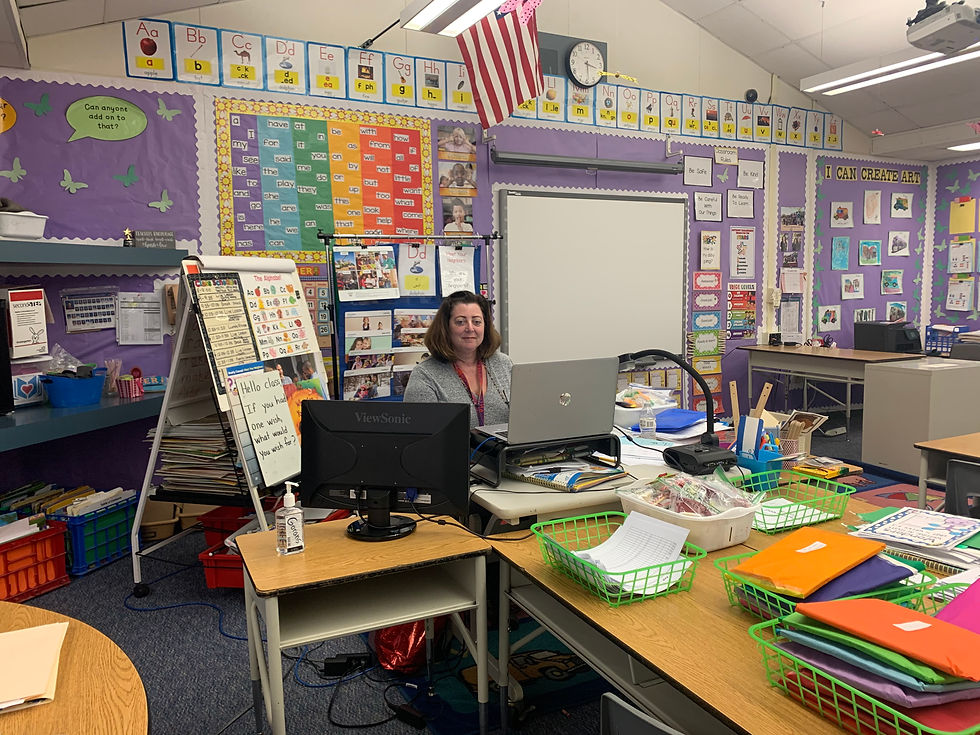
Susan B. Anthony Elementary School, Fresno Unified School District. Lisa Gorans is one of 40% of teachers at Susan B. Elementary School in Fresno Unified School District teaching remotely in her classroom.
Teaching in Title 1 schools are already challenging enough before distance learning, but it has become a lot more challenging for these teachers not having the resources and support they desperately need to help these students succeed during distance learning.
“Many of these students live in poverty. Many single-parents and many whose parents are working are not at home to help their students,” Robles, sixth-grade teacher at Fremont Elementary said. “There are a lot more challenges for students living in poverty... bad connection... no support by parents. There really just is no right way for these students to get the best education if they are not present in a classroom.”
Robles and Gorans are both excited for school to resume in session for students to return to the classroom; however, with Fresno County’s current mandated Stay at Home Orders caused by being back in the most restrictive, “purple tier,” schools must stay closed until the county goes back to red tier.
Fresno Unified School District currently is not allowing classrooms to reopen for students but only allowing in-person instruction for a small cohort of high-need students while the rest continue to learn from home.
This means that kindergarten teacher, Gorans, and sixth-grade teacher, Robles, may not be seeing their students any time soon as Fresno County is still in the purple tier.
Clovis Unified School District, however, has an elementary school waiver allowing some students back in class with modifications that was passed when Fresno County was in red tier. These modifications referring to a small group of students and a hybrid classroom.
Roberto Sandoval is currently teaching fifth grade in a hybrid classroom at Tarpey Elementary School in Clovis Unified School District. He said that for his school a hybrid classroom consists of a small group of students returning to the class for a small amount of live instruction with many safety modifications, and the rest hours of instruction being at home online.
“There are two groups. Group A is the morning group and Group B is the afternoon group,” Sandoval explained. “Group A comes to class from eight to eleven for in-person instruction.
During this time, they usually take tests or in-paper assignments for the three hours. After the three hours, they go home, and they then do online instruction in Google Classroom in the afternoon. Group B does the opposite.”
Sandoval is the only fifth grade teacher at Tarpey Elementary School teaching hybrid. He only has a small group of students, but he enjoys being present in the classroom with his students. He said he hated online teaching because it was so draining for him mentally.
“I just hated looking at the screen all day,” Sandoval added. “I love now being on my feet and actually giving live instructions with the kids.”
Tarpey Elementary School is one of many elementary schools across the district bringing back selected number of students back to the classroom. When Tarpey Elementary first announced the new plan to return students back to the classroom, Sandoval was one of the first teachers at that school, who considered to teach hybrid.


Credit: Roberto Sandoval. Tarpey Elementary School, Clovis Unified School District. Roberto Sandoval is one of the one-third of teachers returning back to campus to teach Hybrid at Tarpey Elementary School in Clovis Unified. His classroom is set up in a way where students are six feet away from each other. Sandoval has two small groups that one group shows up in the morning from 8-11a.m. and the next group comes from 12-3 p.m.
One third of Tarpey’s schoolteachers are currently teaching hybrid back on campus.
From his experiences through the beginning of March he would encounter, such as technological issues and no accountability for the students not doing the assignments or turning on their cameras, Sandoval was desperate in returning to the classroom being present with his students.
“I hated online teaching,” Sandoval added jokingly. “I had too many issues with online teaching. One getting all my students to get their cameras on and two a low level of engagement from my students. I recognized no matter what I did, I would always have students who would not be corporate in getting the best of learning away from the classroom.”
Tarpey Elementary School is also a Title 1 school and many of these students live in poverty and households that have many distractions present during online learning. It becomes a greater challenge for teachers teaching in Title 1 schools to accessibly help and support their students when it’s through virtual learning.
Teaching in a higher income community will look completely different for teachers working remotely during distance learning. In higher income community schools, there are more supportive parents, and more access and navigation on these technological resources supported by parents and the school.
Robles, the sixth-grade teacher at Fremont Elementary, adds that his two elementary school-aged children attend a wealthier school and he sees how well his student’s teachers have in teaching their class due to the high amount of support and resources they receive by the community, parents, and school.
Still it’s not all the same for all students and teachers.
“My kids have us, and most kids where I teach, don’t have what my kids have,” Robles added. “My kids are lucky they have the support they have right now. Most of my students would love receiving the help if they could.”
However, at the end of the day, what benefits most is seeing how teachers across the world and nation continue to try to make a difference for these children seeing how much they are struggling at home and academically. Although it does not seem clear for most teachers what is to come in the next few months of teaching remotely, teachers continue to make a difference in their communities, helping these students succeed and achieve academically.
About the author:
Sandra Gutierrez is a fourth year college student attending Fresno State University in Fresno, CA. She is taking MCJ 2 which is a requirement for Media, Communications, and Journalism Minor. This featured story is part of a required assignment.
Comments